
To begin, I’d like to make clear (as I will undoubtedly throughout this review) that My Neighbour Totoro is a film I hold in an almost unparalleled regard. Hayao Miyazaki’s beloved animated fantasy film is a beautifully and simply crafted gentle masterpiece, a wonderfully whimsical meditation on innocence, nature, and childhood. Studio Ghibli released MNT in 1988, but the film has a sense of timelessness about it – despite not having the traditionally sought-after sense of grand spectacle or high-stakes drama. Miyazaki makes this excel without these conventional elements partly because of his fantastic ability to present wonder and beauty in the smallest moments of everyday life. This, alongside the film’s magnificent ability to make its audience shed their adult hide, and become a joyful kid again (if only for an hour and a half), is clear evidence to the talent of inside Studio Ghibli, a quintessential instalment of animation as cinema.
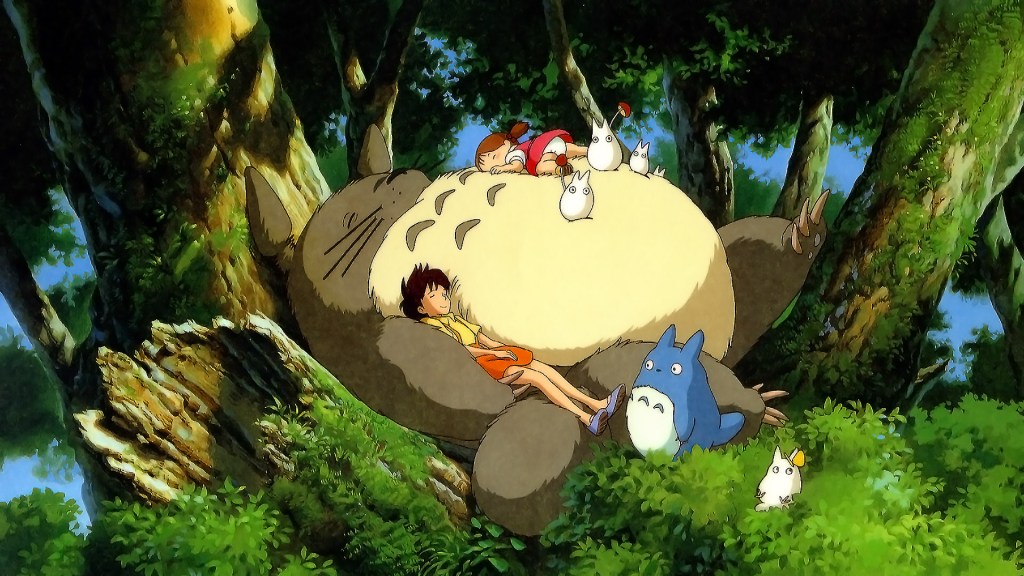
The plot is fairly loose, following two young sisters: Satsuki and Mei. As the two move with their father to the countryside while their mother recovers from an illness in a nearby hospital, they find their new home is surrounded by not only beautifully hand-drawn greenery and towering trees, but a world brimming with the unseen fantasy and the mysteries of nature. From the moment they arrive, an unshakable sense of the quiet magic found in the nature around them begins to emerge. The dust-ball ‘susuwatari‘ (soot sprites) provide our first glimpse into the magic and fantasy of MNT as they skitter in the shadows of Satsuki’s and Mei’s new home. The other pieces of nature that engulf the house is the towering camphor tree that seems to breathe with life and, of course, the gentle, kind and enigmatic forest spirits known as Totoros.
MNT has no villains nor battles, or urgent conflict. Instead, it thrives on Miyazaki’s effortlessly organic storytelling capabilities, in which he allows us to experience this world through a child’s eyes. Here, childhood is a time when reality and fantasy can seamlessly intertwine, embedding a sense of nostalgic whimsy within both the film and the audience. We are all transformed back into children as a simple afternoon rainstorm becomes an unforgettable moment of magic, and a hidden path in the woods leads the audience to encounter the infinitely cute and friendly giant, Totoro.
Miyazaki’s direction is delicately masterful, giving the film its ineffable sense of meticulously crafted detail, fun, and adventure. And for me, it’s really Joe Hisaishi’s score that wraps every scene in that feeling of warmth and wonder. Beneath its whimsical surface, MNT also carries with it an undercurrent of quiet melancholy. The sisters’ deep longing for their mother’s return, Satsuki’s struggle to balance both being a child and caretaker for Mei, and the unspoken fear of loss are all present, yet they never overpower the film’s gentle tone – perhaps for most people it is only when they view the film as an adult do they pick up the sadder subtext. Miyazaki never forces these emotions; he lets them drift through the film, keeping them present but unobtrusive, allowing them to settle naturally.
In rewatching Miyazaki’s love letter to childhood and the natural world, I appreciated this masterful film, which invites us to slow down, listen to the rustling leaves, observe the beauty of the forest, and be a kid again. MNT is, frankly, fantastic. In its simplicity, it is profound. And in its gentleness, it is unforgettable.
Thank you for reading.

 MORTFILMS