
As grand as the misty mountains of the Peruvian rainforests, as strange as a raft pierced by a treetop or one overcome by copious amounts of monkeys, Aguirre: The Wrath of God (ATWOG) is a brilliantly haunting film – Werner Herzog’s specialty. The film oozes a sense of exhilarating chaos and wonderful madness in its surreal voyage into the quest of Spanish conquistadors searching for El Dorado, and every second feels parallel to Herzog’s journey of unyielding ambition and artistry. ATWOG is not only important in it’s content, but also through its context; the haywire production history of the film matches the brilliantly rampageous product and mind of its master.

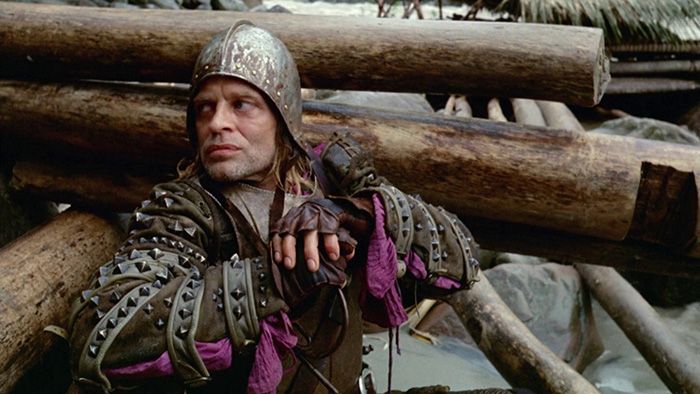
Set deep in the Peruvian jungle during the 16th century, the film loosely follows the famous expedition of doomed Spanish conquistadors into the heart of the Amazon jungle, headed by Don Lope de Aguirre in search of the legendary city of gold – the mystical El Dorado. Herzog presents chaos throughout the film as internal strife breaks out among their ranks and mutiny places the mercurial Don Lope de Aguirre in a position of ultimate, maddening power. In this slow, and sometimes surreal, descent, the audience are forced into a world where reasoning and a grasp of reality disintegrate amidst the oppressive weight of growing ambition.
Herzog’s “best fiend”, Klaus Kinski, delivers a performance that is utterly magnetic, terrifying, and even tragic; he embodies the role of a conquistador as a symbol of monomaniacal will, utterly consumed by the promise of power. The tumultuous relationship between Herzog and Kinski off-screen only adds another layer of madness to the film, with mythologised tales such as Herzog’s supposed threats towards Kinski using a gun, when the actor tried to leave the role 10 days before the end of shooting. Alongside Herzog’s accounts of the screenplay being written with only Herzog’s left hand in two days, the severity of the casts impoverished living conditions causing Herzog to sell his shoes to buy fish to feed them, and Kinski’s daily violent tantrums, the production history of ATWOG is as interesting and important as the final product itself.
The final image is unforgettable and has certainly been etched into my mind; Aguirre alone on a battered, ruined raft, surrounded by a swarm of monkeys, ranting only to ghosts and declaring dominion over a non-existent kingdom – the last ramblings of a madman who believed he could bend the world to his iron will, now swallowed by the vessel he sought to conquer and by his own fatal madness. Hopefully, this is not a self-projection of Herzog, who I believe, while maybe equally as mad, is infinitely talented – as Francois Truffaut said, Herzog is arguably ‘the most important film director alive.’ Little more than five decades since its release, ATWOG remains an unparalleled film in its madness, ambition, and quality. It festers like a fever in my mind, the greatness and horror inside both Aguirre (and, by extension, Herzog) leaving that aforementioned enduring impression of haunting brilliance.
Thank you for reading.
 MORTFILMS