
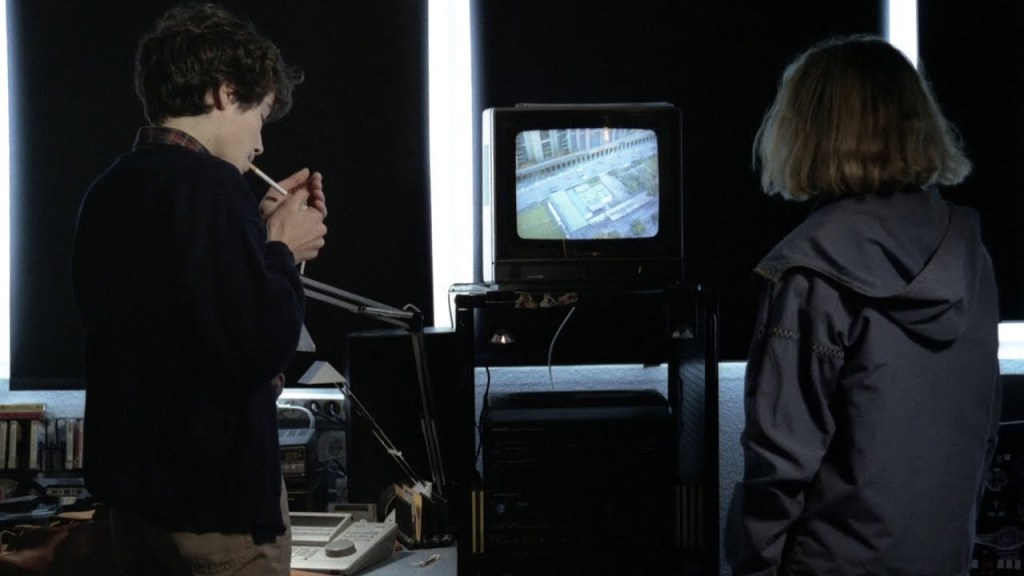
Michael Haneke was inspired to make this film after hearing of a case where a young boy had killed another child just out of curiosity as to ‘what it felt like’, a line repeated by the titular Benny late into this film. 14-year-old Benny spends most of his time holed up in his room watching violent B-movies and/or obsessing over a home video he recorded of a pig being slaughtered with a captive bolt pistol (for reference, it’s the same thing Anton Chigurh uses in No Country for Old Men). He does leave the house occasionally, but it seems to be primarily for the purpose of renting more movies at the video store to fuel his morbid adventures in desensitisation. For anyone familiar with Haneke, or his stance of disgusted shock at the glorification and normalisation of violence in the media, this film offers the same sort of obvious yet potent (perhaps preachy or overly brutal to some audience members) psychological terror and moral depravity, in which the audience are both complicit and helpless to intervene. Haneke is also known for employing societal comments directed at class and parenthood, with both being utilised to perhaps indict the source of Benny’s sociopathic behaviour and violent actions upon his neglectful and well-off parents. Both parties prove themselves to be thoroughly horrifying and almost sickeningly entertaining.


Ulrich Mühe and Arno Frisch act in this as ‘precursors’ to their characters in Haneke’s tremendous 1997 film Funny Games, a film which shares a lot of thematic links, perhaps just more artistically fleshed out, with Benny’s Video. At the forefront is this terrible fear that Haneke presents that people can do a lot of abhorrent and violent things, regardless of whether they should. In Funny Games, violence is committed upon a middle-class family; in Benny’s Video, however, violence is committed from within that demographic and then protected by it. There is a particularly jarring scene of social critique as the mother and father discuss what course of action they should take after Benny shows them the murder of a similarly aged girl that he committed, in all its slow and arduous detail, recorded as a home video. Their reaction is one of quiet disgust, but they soon focus on how they can avoid any legal action and keep their son from any consequences, making a list of pros and cons as to Benny’s chances of getting off lightly and notably conveying little (if any) remorse for the girl he murdered or serious condemnation of their son. While Haneke’s take on violence is perhaps a bit axiomatic and even slightly pompous to some, I find his depiction of it in play with upper/middle-class anxieties and solipsist parents plagued with narcissism to be a wonderful critique of the self-saving parental mindset in this film: the notion that their own child can do no wrong, only the children of those around them. Of course, their children become an extension of their own egocentrism. I believe where this film shines is in Haneke’s symbolisation of the tragedy of this type of self-absorption in combination with the grimy indoctrination of the public by televised violence within these characters to make a chilling psychological horror/crime hybrid.
Thanks for reading.
 MORTFILMS