
If David Lynch’s films can be read (in the most understated way) as the contrasting of suburban American society with its dark, seedy underworld in a wonderfully surrealist fashion, then it is true of Todd Solondz’s films, and Happiness in particular, that they can be read as the blending (or even total consumption) of suburban American society with underlying and perverse malice and darkness – rather than a perhaps more Lynchian juxtaposition of the two. In Happiness, there are very few, if any, characters who embody and promote the American Dream, rather than twist and subvert it, simply by being deeply human. Every character in Happiness, and every scene by extension, draws a sense of pity, disgust, and hilarity from its audience, looking upon the almost helplessly pathetic, petty, perverted, and supine situations Solondz draws. The viewer is positioned to feel a mix of both empathy and disgust for the outcasted characters Solondz conjures, with those two elements working in conjunction to create perfect black comedy that takes those extremely unfunny and frankly depressing situations and squeezes every possible laugh out of them and the melancholy they exude.

An ensemble piece—think a perverse Robert Altman work—Happiness boasts a wide range of brilliantly pitiable characters. We are first introduced to Joy (Jane Adams), who is on a dinner date with Andy (Jon Lovitz). In an absolutely hooking opening scene, which fantastically sets the scene and tone for the rest of the film, Joy breaks up with Andy in a (I believe to be) unknowingly mean fashion, with one of the funniest lines in the film coming when Andy asks if Joy is seeing anyone else, and she responds, ‘No, it’s just you.’ A moment meant in earnest to comfort the afflicted party stings with a bitter edge of loneliness. Joy wasn’t cheating on Andy or found something/someone more attractive and suitable, but it is rather his being that is unappealing, a hilarious moment of degradation that somewhat builds our sympathy for this seemingly sweet but unlucky or unloveable man. Solondz further coaxes us into feeling bad for Andy, who upon rejection uncomfortably cries and looks with immense sadness in his eyes throughout the ordeal before showing Joy a gift he had brought for her, a presumed gesture of kind sincerity despite the unfortunate situation having torn him down. As Joy comments on how lovely both Andy and the gift are, Solondz lowers the character from being pitiable and relatively sympathetic to hilariously pathetic and petty, as he snatches the gift from Joy and claims he was just showing her a slice of ‘what she was missing’ and then says of the pair, ‘I’m champagne, and you’re shit. Until the day you die, you, not me, will always be shit.’ In dragging himself down to the lowly pettiness of what would today definitely be akin to an incel who spends too much time on Reddit feeling sorry for himself, Andy immediately showcases the underlying spitefulness present within every character in Happiness. Jon Lovitz is great in this small role at being both pathetically meek and then, in an instant, switching to being full of slimy pettiness. The two sit together at the restaurant in a sustained two-shot, not talking, before the film releases us from the awfully awkward situation by cutting to the next scene.
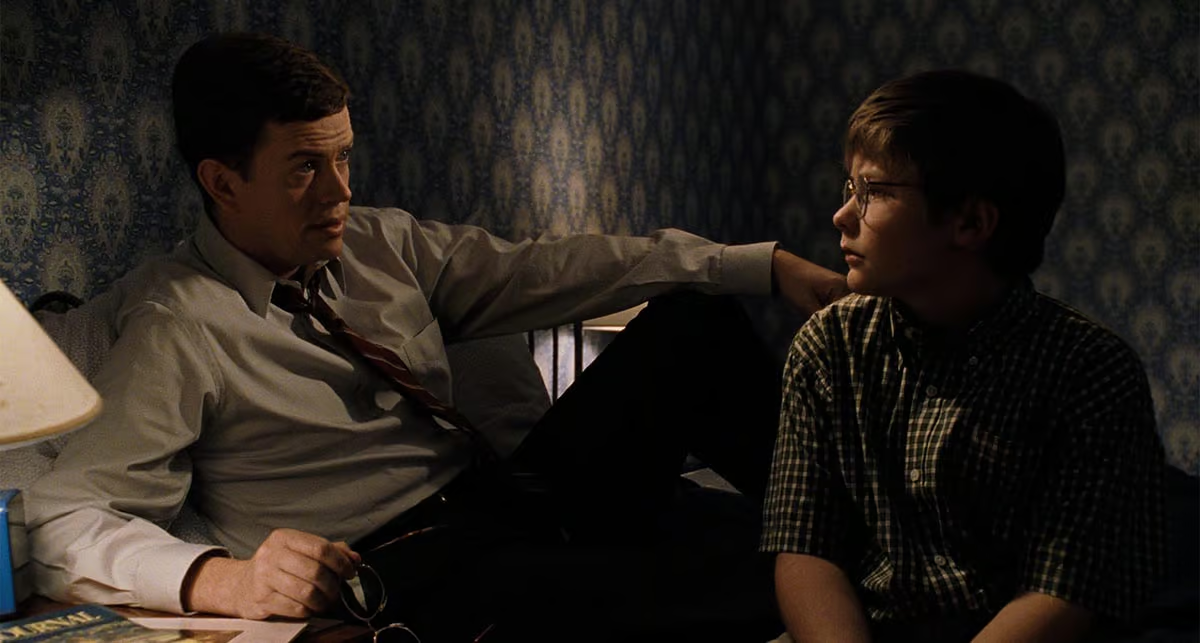
But the break from the bleak yet comically genius affairs doesn’t last long, as we move from awkward despair to a more disgusting despair. A close-up shot depicts the face of Allen (Phillip Seymour Hoffman), who is introduced rambling on in distress about his depraved pornographic desires to his therapist Bill (Dylan Baker). Clearly bored, as shown by his recalling his shopping list rather than actually listening and responding to Allen’s problems, Bill represents an urge to escape from the crutches of banality that accompany work and suburban American society as a whole (a theme that would be exemplified further in Sam Mendes’ American Beauty, which was released the year after Happiness, in 1999). However, Bill harbours a more extreme evil than just being bored at work. He is a therapist, family man, and serial rapist with exclusively pedophilic preferences, who also seems to have recurring dreams about killing others; he is almost certainly the character that Solondz makes the audience feel like awful, low-life human beings for finding funny. It should be noted that none of his actions are condoned (and there are no rape scenes shown, they are all off-screen events), but more presented as pathetic and vile expressions of pain and sadness, as with the actions and traits of all the characters, in creating moments of jet black humor within this plotline – such as in one of the last scenes where Bill’s son worries if he’d ‘rape him’, to which Bill replies with a defeated and heartbreakingly honest admission of ‘…I’d jerk off instead.’, as if that lessens the situation or makes up for any of his vile acts, cementing a situation so disgusting, pathetic, and cringe-inducing to think about, that laughing becomes simply a means of escaping this depravity.
Bill’s wife and Joy’s sister, Trish (Cynthia Stevenson), is a perfect representation of a special breed of ‘Surburban Snobbery’. She lives totally unaware of the cruelty of her words and frequently cites to Joy that she and the rest of their family all thought she’d ‘amount to nothing’. The poor, downtrodden, Joy is probably the character I feel the ‘purest’ sympathy for, where the meekness of her character and circumstances are not equally laced with disgust or dislike. Joy is constantly berated and disdained by her family and peers, in ways that seem to be unconsious surges of cruelty on their behalf. The treatment of Joy embodies Solondz satire of the (sometimes not so) subtle terror Suburbia inflects on its most innocent inhabitants. Trish’s eldest son, Billy (Rufus Reed), is on the cusp of puberty, and is seemingly serenated constantly by the tall tales of sexual achievements and statistics by others in his school. Throughout the film, he frequently engages in ‘birds and bees’ conversation about sex with his father (these are genuinely painful to watch, both in the tension of knowing that Bill Sr is a pedophile and in the taboo discovery of the subjects, and that is part of the scenes’ comic and artistic brilliance), and strives to have his orgasm as soon as he can. Joy and Trish’s sister, Helen (Lara Flynn Boyle) is a poet, ignorant and self-centered, she constantly regards her life as woeful and frequents mentions the numerous men who lust for her and the great sex she is always having, though she finds it to not be enough, and wants someone who is honest with her. Allen, in his immense perversion, lusts over her greatly and engages her in phone-sex as he does with many other unknowing recipients to bring himself pleasure. (There is a gross yet iconic shot of his cum spurting onto one of the walls of his apartment). The sisters’ parents, Mona (Louise Lasser) and Lenny (Ben Gazzara) are equally unhappy as the rest of the characters in the generation below, with domestic tensions arising as Lenny decides he wants a separation (not a divorce!), simply to be alone.
Other characters in this vast ensemble piece (I’m finding it easier to delve more into the characters rather than the plot, both to not spoil anything major, and because it is really an ensemble driven piece, with each sad and pathetic vignette of each equally sad and pathetic – yet simultaneously hilarious – character driving the plot as they intertwine with one another) include Kristina (Camryn Manheim), a lonely lady who lives in the same apartment as Allen and Helen, and tries to woo Allen with the news that the apartment doorman has been murdered and dismembered (a charming conversation starter to which Allen promptly responds with by continuing to do nothing but leaf through porno mags and masturbate to the victims of his phone-sex calls), and Vlad, a Russian student who engages in a romantic relationship with Joy in the latter part of the film.
Whether the audience laughs ‘at’, or ‘with’, the characters, the scenarios they find themselves in, and the themes of the film, is of course dependent on each individual viewer, but personally I remain unsure; hoping to lean towards the latter but knowing I’m probably closer to the former. Solondz points to this biting cruelty within all of us that the film thrives on in one of the last scenes. As the consistently aloof Helen says to her sister Joy, ‘I’m not laughing at you, I’m laughing with you!’, only for the bewildered Joy to admit ‘But I’m not laughing…’, we are plunged into challenge of if we really should be – as moral, ethical, and civilized citizens who might like to think of themselves far-above the characters presented here – laughing at the banality and dullness present in the film and Solondz view of Surburban American Society. A deliberate scene of tragic comedy, this moment highlights the apparent cruelty of the films humor, and how we should maybe all feel (at least a little) guilty for finding immense joy in the dismal lives of the lowest in society, and people who themselves, have very little humor in their world.
Comedy and tragedy ensue throughout Happiness, often at the same time, as the various interconnected characters all navigate their own personal grievances, desires, and stems of unhappiness while trying to belittle and/or avoid the others around them trying to do the same. Suburbia is less of a community in Solondz vision but more of a dystopian institution of misery, inviting us to laugh at his darkly genius subverted view of the once grand American Dream.
Thank you for reading.

 MORTFILMS