
‘I despise people who can’t control themselves,’ is the opinion Perry Edward Smith (played here by Robert Blake) boasts to himself as he stops his partner in crime, Richard Eugene Hickock (Scott Wilson), from raping a young girl, one of the four members of the Clutter family the two have tied up in their attempted robbery of the wealthy farming family. The irony of the sentence speaks volumes, as the two eventually kill all four members of the family, one by one, in a showcase of exceedingly brutal violence. The shred of morality shown by these men is negated a hundredfold as they escape the scene and drift across and out of America, looking for more ways to score and more people to kill and rob. Meanwhile, the small community of Holcomb, Kansas, is plunged into paranoia and questioning, alongside detectives Alvin Dewey and others, who work to identify and bring justice to the perpetrators of such a shocking crime.

One year after Truman Capote published his defining work, In Cold Blood, he supervised the production of a film under the direction of Richard Brooks of the same name as his book, bringing his fantastic work of journalism and the chilling evil of the crimes detailed in it to the screen. After finishing the book earlier today, I decided to give the film a watch, having picked up the Criterion Blu-Ray of it quite a while ago.
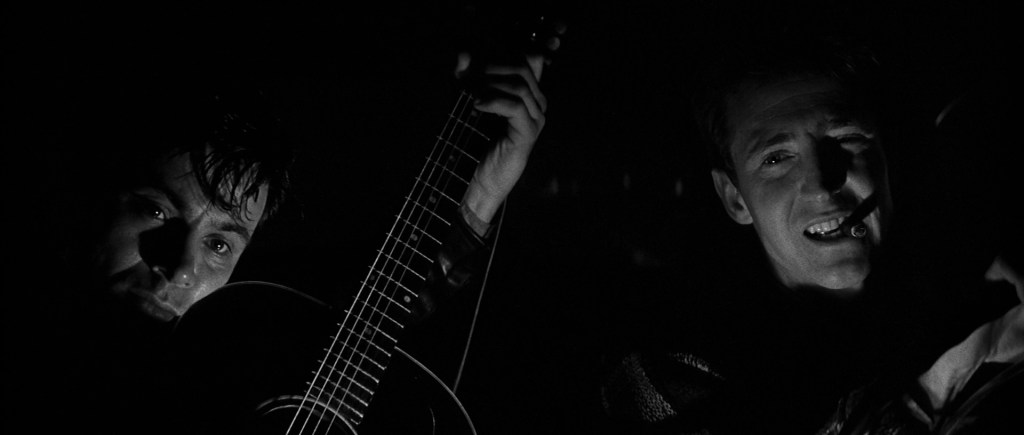
The seediness of the American criminal underworld seeps into seemingly idealistic small-town American society as the two central drifters, Dick and Perry, pursue crimes ranging from petty thievery and bouncing checks to attempted murder and—of course—successful murder. Brooks and Capote agreed on the decision of making the film a black and white picture to associate it more with how documentaries looked in the 60s (with most archival footage often being before colour film) and to create a sense of verisimilitude and evoke the realism of the events, replicating the ‘true crime’ genre the book popularised onto the silver screen. However, I feel the style of the film, meant to evoke the feeling of watching a documentary, is more like watching a noir film. The cynicism of the story itself and the certainly morally questionable main characters of Dick and Perry, coupled with the stylistic aspects of the extremely low-key lighting and use of darkness to fill the frame as it fills the characters minds, consuming them (for example, in the scene where the details of the murders take place, total darkness except for the glow of Dick’s flashlight encompasses the audience in the evil of the scene and provides for some genuinely chilling moments), and the themes of criminality running throughout—as the film turns into a dark cat-and-mouse chase between Dewey and the Clutter Killers as they become identified as the perpetrators. The first scene, where we see Perry plucking his guitar at the back of a bus, his face shrouded in complete darkness before the camera pushes in to reveal the enigmatic drifter, is incredibly reminiscent of the noir genre and immediately cements that stylistic aspect of the film, blending the documentary style with the noir style, arguably merging two genres of crime films (though the ‘true crime documentary’ wasn’t popularised yet) into one work of immense darkness.
Chosen for their likeness to the real Dick Hickock and Perry Smith, Scott Wilson and Robert Blake inhabit the killers with precision, and both perfectly portray that uncomfortable blend of suave drifters and ruthless criminals that make up the core personalities of both Hickock and Smith, while adding each individual’s own quirks in as well (Smith’s childhood trauma and Dick’s sexual perversion, for example). Casting the unknown (and still underrated!) actors, and not Columbia Pictures’ original choice of Paul Newman and Steve McQueen, was an excellent choice on behalf of Brooks, as the prestige of Newman and McQueen would’ve turned the characters from frighteningly troubled men into more rough-edged antiheroes, which in turn I feel would’ve lessened both the real actions of Hickock and Smith and inaccurately portrayed both the men and Capote’s book. Additionally, this film catapults itself into the new era of Hollywood, with several violations of the dwindling Hayes Production Code in terms of graphic imagery and language, forcing a more realistic and darker look at the story. Released the same year as Arthur Penn’s Bonnie and Clyde, this film should be regarded as one of those early exhibitions of artistic freedom in Hollywood, helping to push filmmaking in America to new boundaries—and new levels of fascinating depravity—of what could, and should, be shown to audiences.
The escapades of the characters are gripping and as darkly fascinating as Capote’s writing (with several parts of dialogue being true to the actual conversations and words of the characters in real life), and in what I felt to be an admittedly quite forced interjection of himself as a narrator-type character detailing the characters story once they land on death row in the final act, Capote’s own standings on criminality, justice, and the issues of capital punishment and class divide provide candid social commentary and leave the audience with plenty of issues and discussion of American society to consider themselves. If you like Capote’s book of the same name and if you want to see some of the roots of the true crime genre, I will certainly recommend this film to you.
Thank you for reading.
 MORTFILMS